The endeavour to understand the nature of time is an inherent need of the mind. Scientifically, it is unclear when humans attained the level of self-awareness, that is, the ability to reflect on their own existence. Astrologically, the esoteric influence of Sirius and increasing responsiveness to it over the course of millennia are said to have enabled the emergence of self-consciousness.
The milestone transition in evolution is placed around 100,000 years ago. The earliest findings of carved symbols, animals or even constellations in caves, testify to Homo sapiens’ ability to understand abstract meanings and most of all, to their desire and need to express them.

The persistence of memory (1931) ~ Salvador Dalí
The attainment of awareness of our individuality as finite beings (personality) along with the use of the mind, automatically gave rise to the perception of time.
Thought without time cannot exist, nor can the opposite.
On one hand, thought is a great gift that helps us organize and understand the world. On the other hand, it can only function within the linearity of time, as it relies exclusively on the memory of the past and projection toward the future.
By definition, it is limited and incapable of functioning in the infinity of the present. Its role is divisive, not unifying. This is why identification with it can become a trap: the captivity in the egoism of the lower mind, incessant thinking and its use for issues it is not capable of handling, such as existential matters and anything requiring the higher function of intuition, instead of the lower one of logic. A barrier that every student of esotericism must eventually face.
This is a fundamental function of astrology: the ability to manage, measure, organize time and ultimately, to free oneself from it.
We now arrive at a foundational principle in the approach to an astrological chart, one that is rarely discussed: The separation of time into subjective and objective, short-term and long-term. This distinction plays out between the prison of hypnotized everyday life and the infinite spiritual evolution of absolute freedom.
A differentiation upon which human psychological progress is based, and through which one can transition from attachment to the earthly ego, to the expression of the soul.
Two directions
Something that all people can easily understand is that the Sun and all the celestial bodies along the ecliptic (the path the Sun traces across the sky) rise in the East every morning and set in the West every evening. Who could argue that this is not the natural order of things?
Yet, this course represents the vicious cycle of day and night. The attachment to the routine of waking up, going to work, eating, seeking pleasures, avoiding resistance, looking for temporary escapes, sleeping and repeating the cycle with the hope that the weekend or the summer vacation will soon come. A survival cell between the banks of pleasure and pain, until one more incarnation ends.
A movement that, during a 24-hour period, one can observe in an astrological chart or in the night sky, appears seemingly opposite to the position of the constellations and correspondingly, the 12 houses.
The natural order of the 12 zodiacal constellations is arranged from West to East.
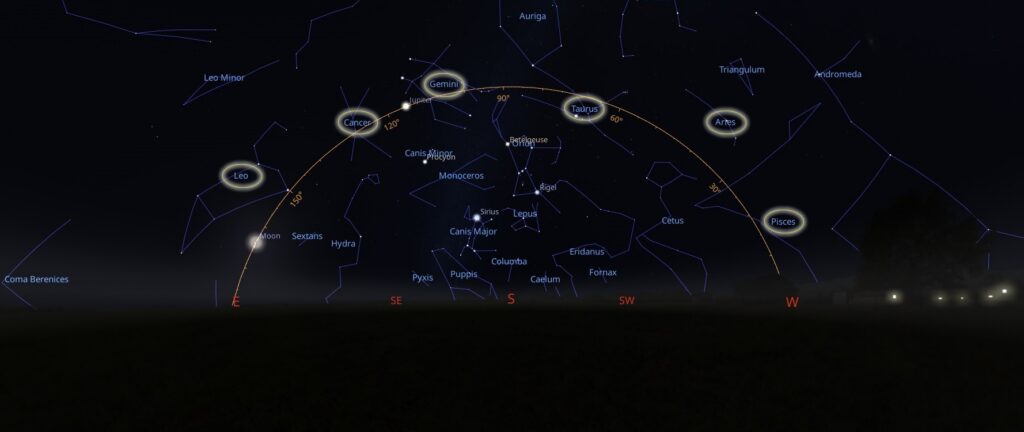
On one hand, the first direction (subjective) is short-term and lasts for 24 hours. It is determined by the Earth’s rotation around itself. A ‘selfish’ rotation that gives the impression that the entire celestial dome travels around the human and their personal life.
On the other hand, the second direction (objective) is long-term and has neither a beginning nor an end. It could, for example, be defined by the 27 day lunar journey through the 12 zodiac signs, the 248 year cycle of Pluto’s return or even greater astrological cycles spanning millennia.
It is at this point that astrology offers the greatest assistance in helping a person make the transition. Its primary function is, of course, not prediction: a habit stemming from the human ego’s need to cover its insecurities and the inability to accept and work with the present moment. Its great gift is self-knowledge and the provision of a blueprint of our individual evolution through the cosmic spiral cycles.
The passage from subjective to objective time occurs through a change in consciousness, a shift in our inner attention. That is, through one’s effort to stop functioning within the dualism we described above and to focus on the inner and spiritual path.
The common use of astrology up to now has focused on the examination of isolated events without integrating them into a broader cycle of evolution. In this way, the lower mind is compelled to perceive them short-sightedly as either positive or negative, something that goes against the very nature of astrology itself. As a result, the notion of spiritual progress becomes fragmented and the human perception of reality is distorted, reducing the individual to a powerless being in search of comfort or avoidance of pain.
But how is the course of objective time recognized in a chart? This begins with the realization that each planetary position represents a station along a greater cyclical journey.
For example, a conjunction (0°, planetary alignment) signifies a beginning, as the planets inaugurate a new journey. At their first square (90°), this path encounters its initial resistances, because when you embark on an endeavour, you take up space and inevitably face obstacles. Within a limited astrological perspective, the square is viewed as something negative that causes problems and disappointments. However, from a holistic viewpoint, it becomes clear that it simply calls for a redirection of action and serves as a guide to achievement and progress.
Similarly, the esoteric interpretation applies to each planetary correlation, whether of short duration (such as the 29.5 days of the lunar cycle) or spanning centuries (e.g., the synodic cycle of Pluto and Neptune lasting half a millennium). This allows for both the management of our daily lives toward a healthier way of living and the deeper spiritual journey of our psyche into the distant future. Each aspect provides a guiding message which, when understood internally, shifts consciousness and can bring about nothing but evolution.
Sources:
Rudhyar, Dane. The Astrology of Personality: A Re-Formulation of Astrological Concepts and Ideals, in Terms of Contemporary Psychology and Philosophy, 1936. New York: Lucis Publishing Company (Lucis Trust).
Rudhyar, Dane. The Clock of Your Inner Life, Horoscope Magazine, August 1967.
- Rudhyar, Dane. An Astrological Triptych: The Illuminated Road, Santa Fe, New Mexico: Aurora Press, 1968.